Our team at the University of Chicago engineered a wearable that lets users
see with their hands: a miniature camera on the palmar side captures
what the hand faces, and an electrotactile display renders it as
tactile images felt on the skin. This sensory substitution is developed for
Blind and Low Vision users. Hands move fast, reach from any angle, and
preshape to grasp, so this new perspective opens a way to
support manual tasks in everyday life without vision.
The perspective. A fresh perspective for sensory substitution: putting
the camera on the palmar side and the tactile image on the back of the hand.
The ergonomics. In our study the hands’ perspective suited
ergonomic reaching, and relocating the array to the hand prioritises dexterity.
Not a replacement. It combines with the traditional eyes’
perspective; given the choice, all participants used both.
A new tactile perspective designed for grasping objects
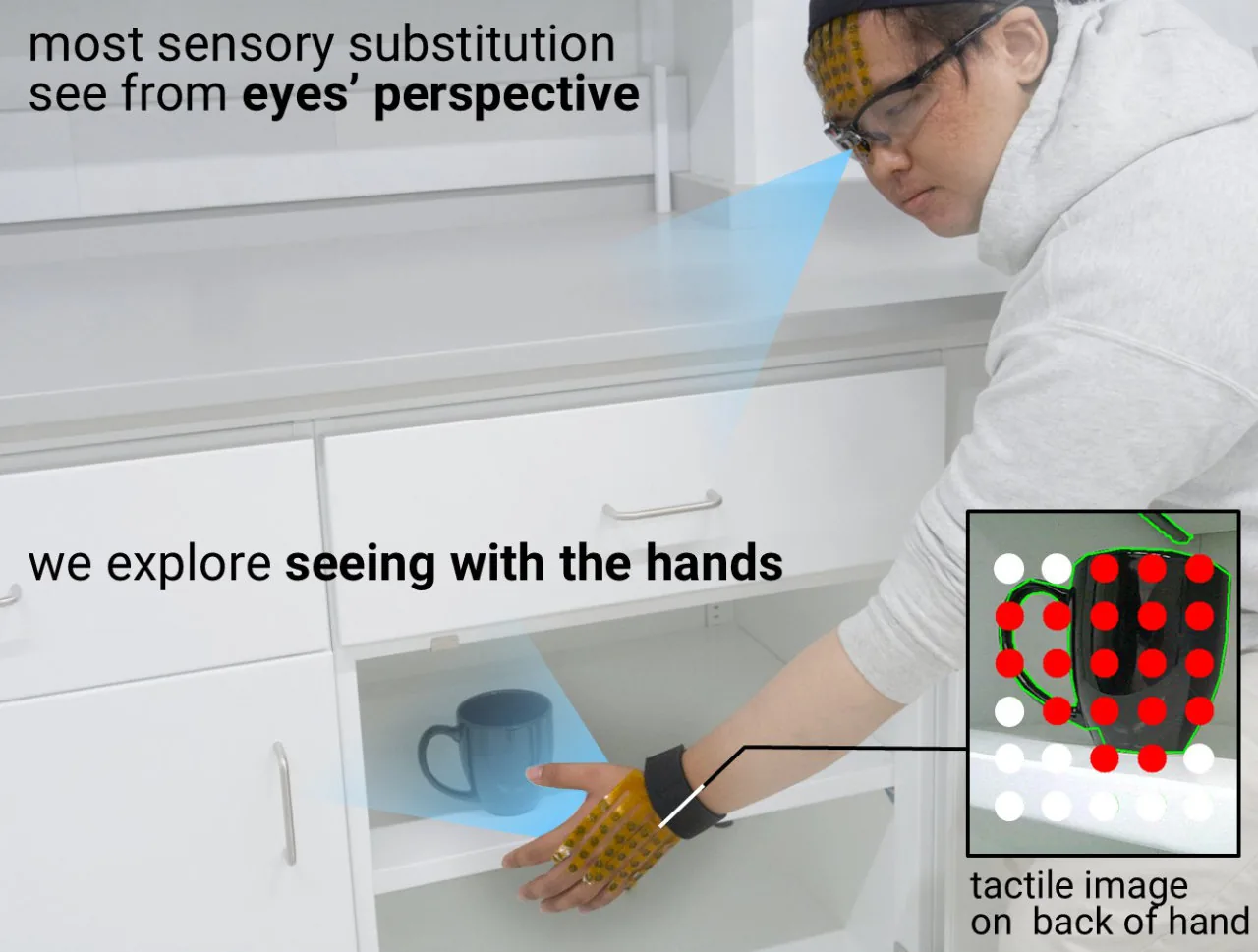
Instead of substituting for the eyes, we put cameras on the
palmar side of the hand, aimed at the objects you reach for.
Typical sensory substitution interfaces are thought to substitute the eyes for assisting
with perceiving one’s surroundings (e.g., navigation). We explore a new tactile perspective
with cameras on the palmar side: the side of the hand facing toward
objects to grasp for hand manipulation.
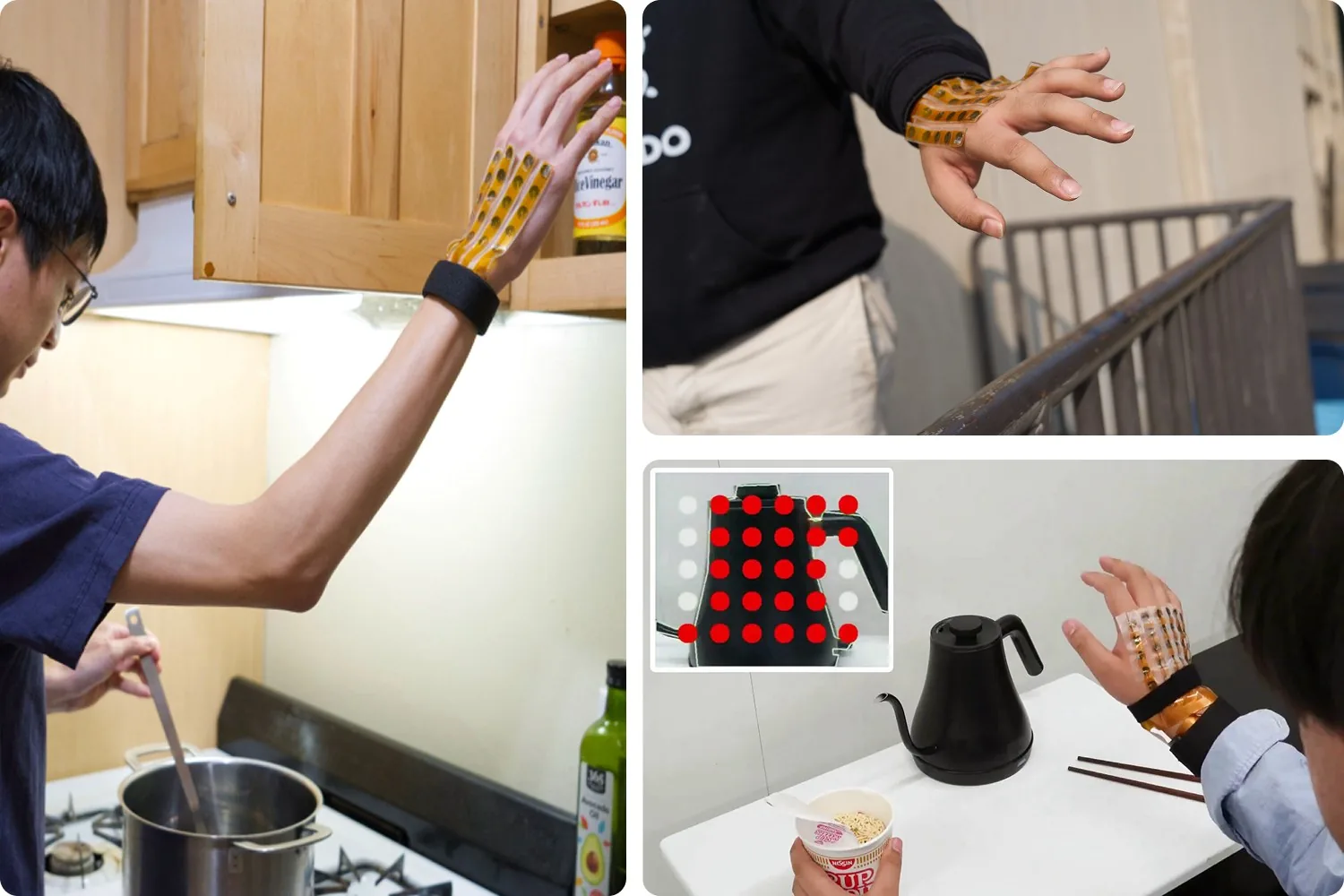
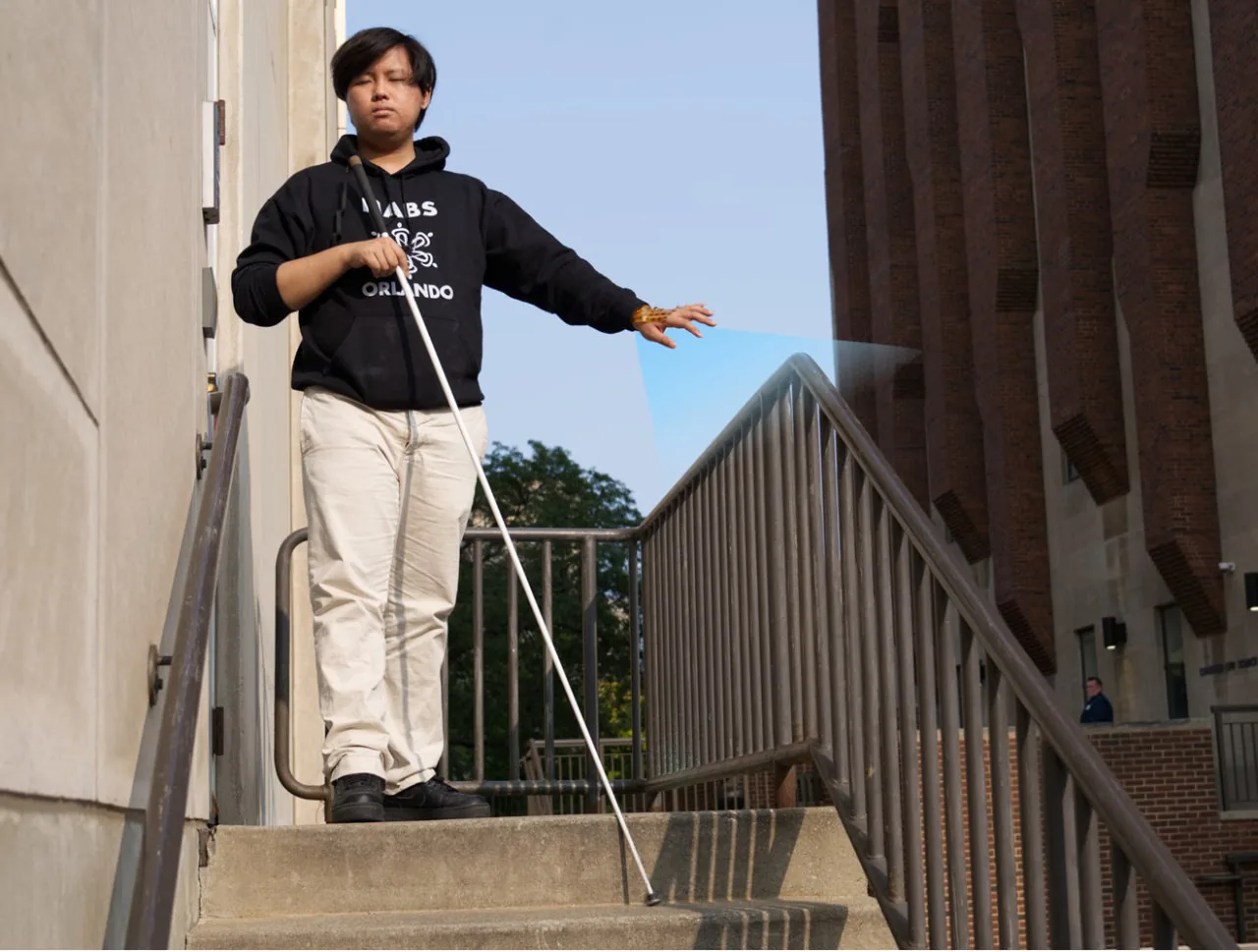
Our study participants envision using our device for various manual tasks, such as
finding the handrail while walking down the stairs, identifying and grabbing
ingredients inside a shelf while cooking, retrieving an object that fell on the floor, etc.
Implementation
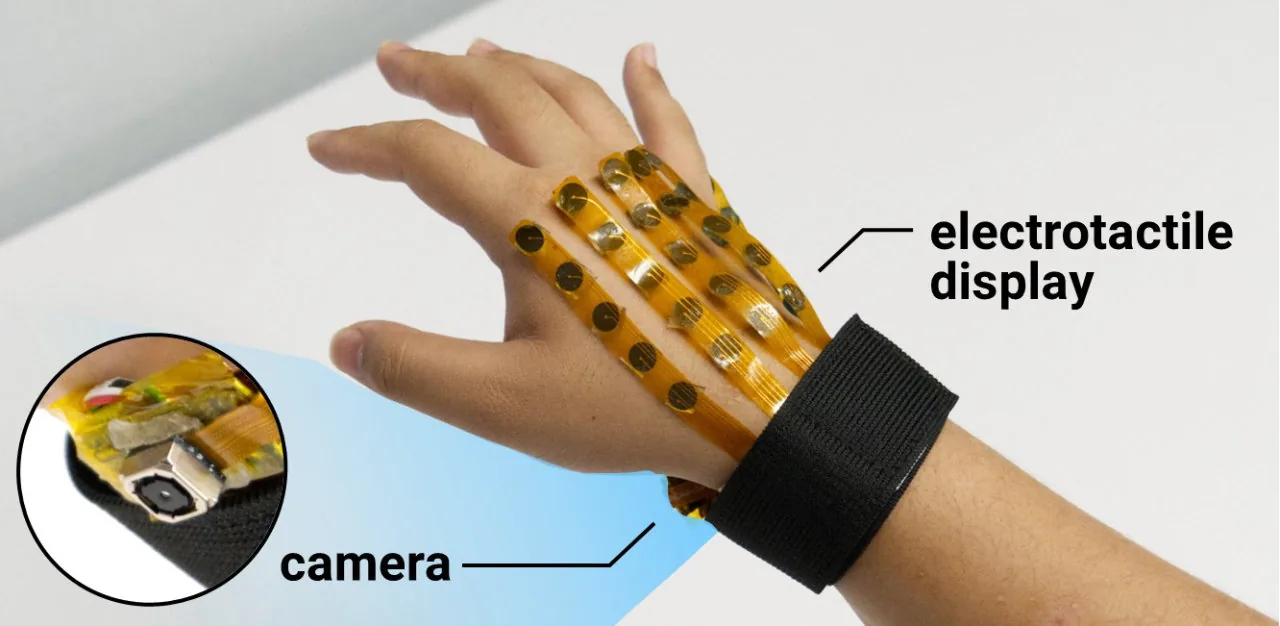
A palm-facing camera and a thin electrotactile grid on the back of the hand turn what the
hand sees into patterns you can feel.
The image under the hand captured by the camera is segmented and translated into tactile
patterns, using computer vision techniques, in real-time. The tactile patterns are felt on
the back of the hand through a custom electrotactile display (5×6) that is flexible and thin
(0.1 mm).
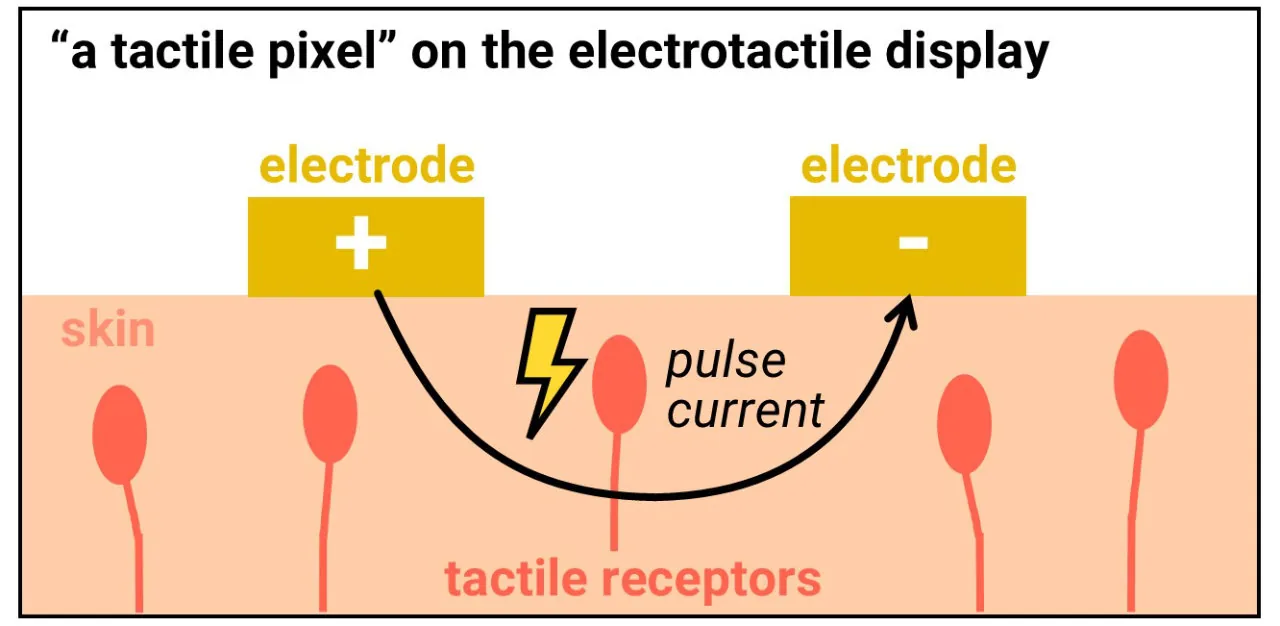
Each “tactile pixel” on the electrotactile display consists of a pair of electrodes. Whenever
the pixel is supposed to be felt, our system passes tiny current pulses (3-5 mA) between the
electrodes, which stimulate the tactile receptors under the skin, causing a sense of slight
touch.
User study
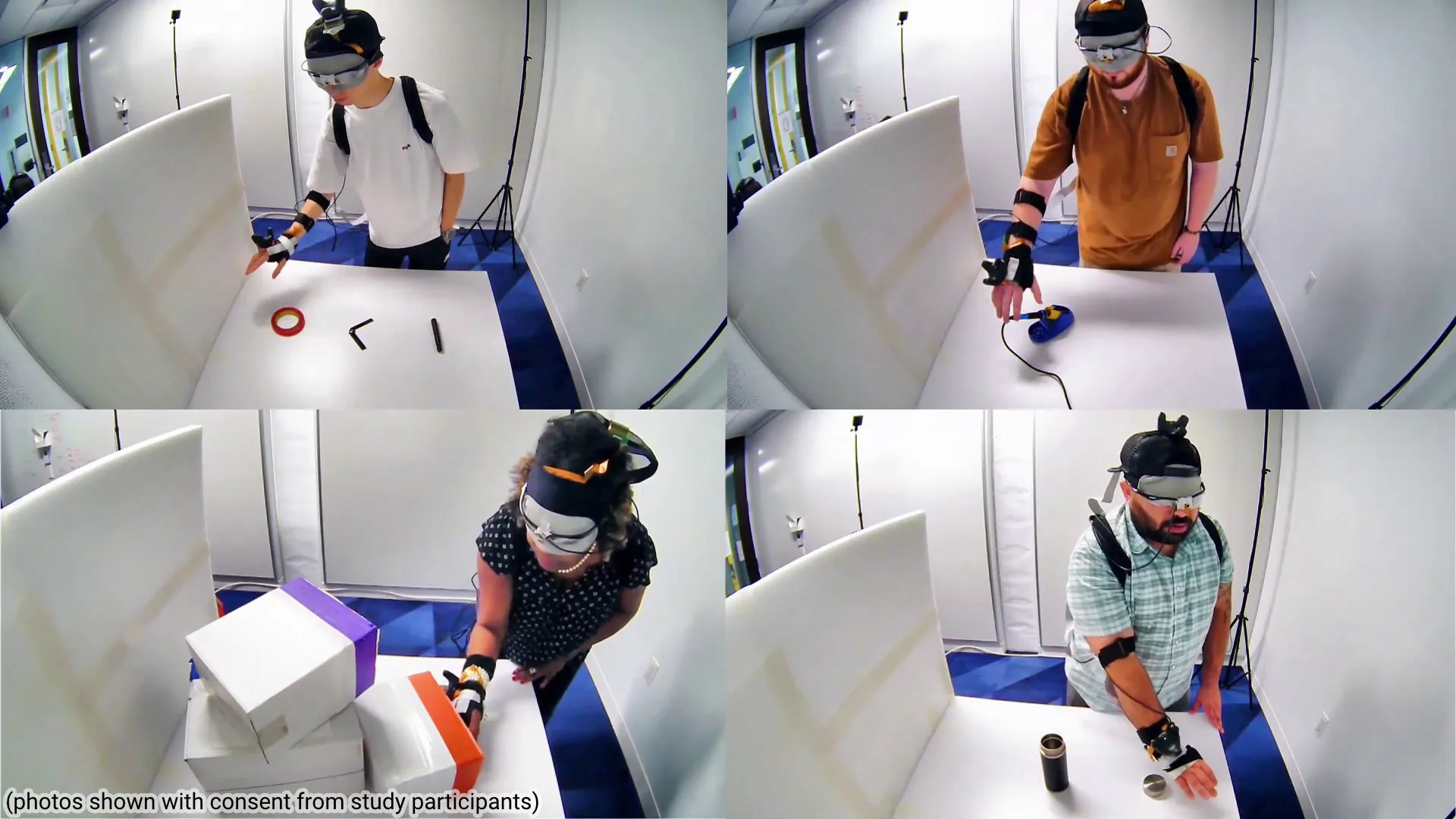
Blind and low-vision participants used the device for grasping and everyday manual tasks,
often after only about 15 minutes of practice.
Our user studies including Blind & Low Vision participants focus on daily tasks
(e.g., grasping objects). Without extensive training (~15 min), most participants completed
not having to touch unintended objects. Compared to using the eyes' perspective, participants
found the hands' provides a more ergonomic way of seeing.
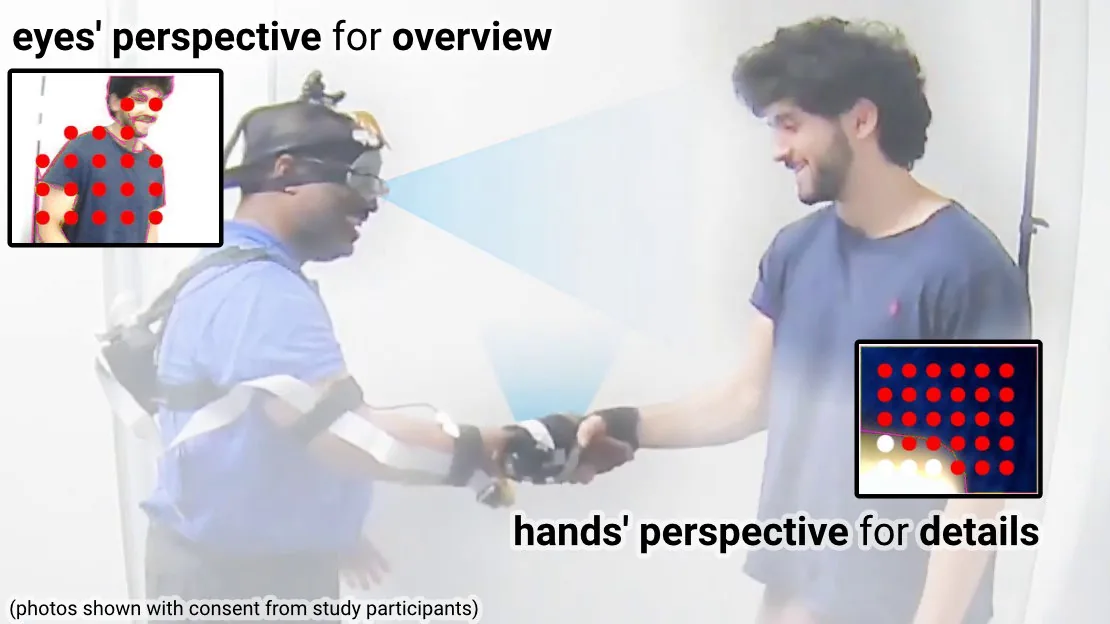
We further let participants choose which tactile perspective to use for a
handshaking task. All chose to use both devices, and most stated that the
eyes' provides an overview, and the hands' provides details.
We were really impressed by how they were able to fluently utilize these new tactile senses!
Shan-Yuan Teng*, Gene S-H Kim*, Xuanyou Liu*, and Pedro Lopes (*equal contribution). 2025.
Seeing with the Hands: A Sensory Substitution That Supports Manual Interactions. In CHI
Conference on Human Factors in Computing Systems (CHI ’25), April 26–May 01, 2025, Yokohama,
Japan. ACM, New York, NY, USA, 14 pages. https://doi.org/10.1145/3706598.3713419
@inproceedings{teng2025seeing,
  title={Seeing with the Hands: A Sensory Substitution That Supports Manual Interactions},
  author={Teng, Shan-Yuan and Kim, Gene S-H and Liu, Xuanyou and Lopes, Pedro},
  booktitle={Proceedings of the 2025 CHI Conference on Human Factors in Computing Systems},
  year={2025},
  doi={10.1145/3706598.3713419}
}
Resources
Press kit:
High resolution photos and unannotated video are available
here.