Overview
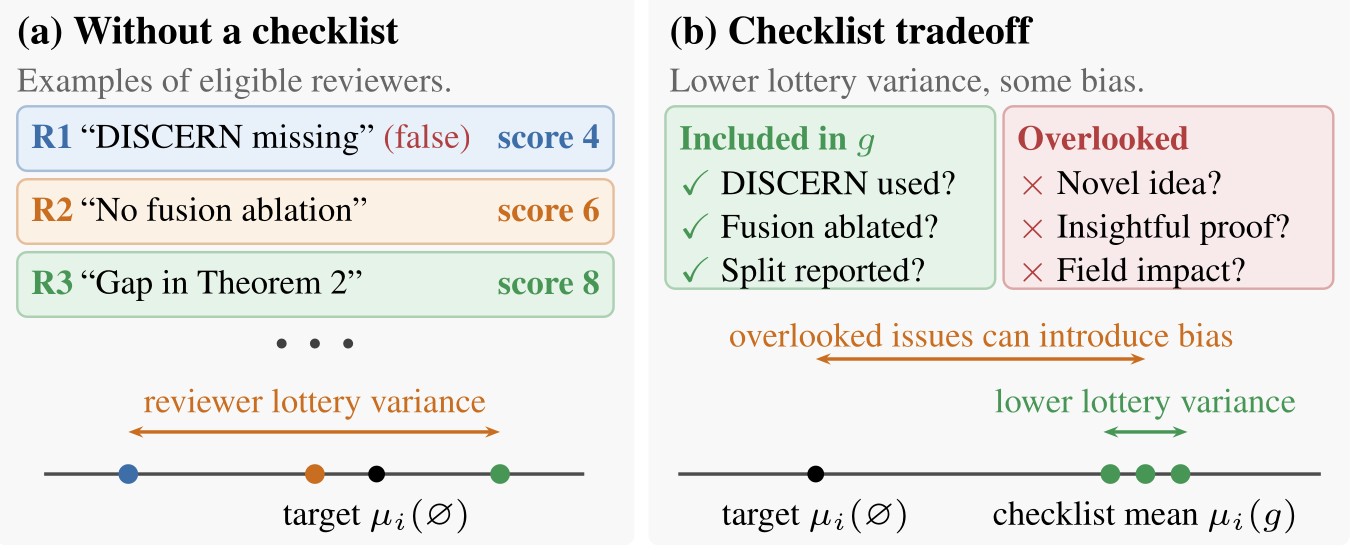
Peer review is partly a lottery. A paper gets three or four reviewers, and each one notices only a handful of the issues a larger pool would raise. Swap in a different committee and the verdict can change.
We learn a checklist from thousands of past reviews and show it to every reviewer, so each committee starts from the same baseline checks. The hard part is granularity: too specific and items never recur, too broad and they fit every paper. We pick the level at which reviewers of the same paper agree most, beyond what reviewers of different papers share by chance.
The problem
In the NeurIPS 2021 experiment, every paper was reviewed by two independent committees. We broke each review into atomic claims and matched them across the two committees to see how much reviewers actually overlap.
A shared checklist can fix part of this: every reviewer checks the same things, and checkable facts get checked correctly. But a checklist also steers attention. Anything it leaves out may get less weight from everyone at once, which shifts the committee's average away from what unaided reviewers would conclude. A good checklist is one where the variance it removes outweighs the bias it adds.
Method
The pipeline reads a historical review corpus and grows one tree of checklists. Cutting the tree near the root gives a few broad items; cutting near the leaves gives thousands of narrow ones.
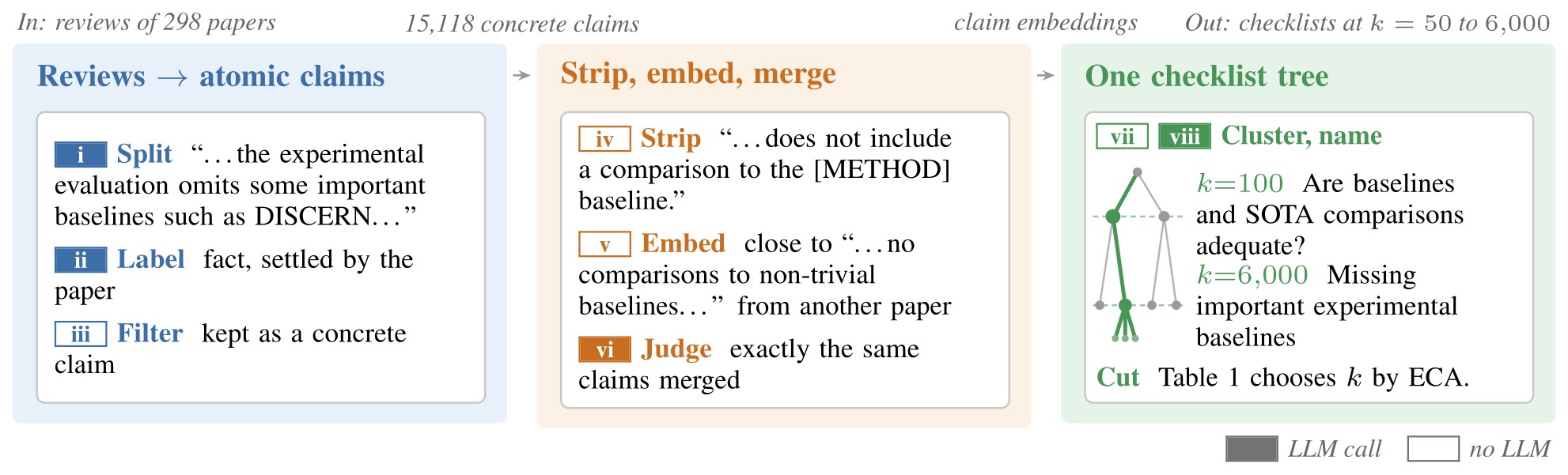
Which cut should reviewers see? Past reviews cannot tell us how reviewers would have scored with a checklist they never saw, so we cannot measure error directly.
Instead we score each cut by expected correlated agreement (ECA): how often two reviewers of the same paper raise the same item (Asame), minus how often reviewers of two different papers do (Adiff). Broad items inflate both terms, narrow items shrink both, and the difference peaks in between. We prove that, under stated conditions, the ECA-maximizing checklist approximates the one with the lowest error.
| Items k | NeurIPS 2021 | ICLR 2022 | ||||
|---|---|---|---|---|---|---|
| Asame | Adiff | ECA | Asame | Adiff | ECA | |
| 50 | 22.1 | 12.4 | +9.8 | 38.9 | 27.2 | +11.7 |
| 100 | 16.2 | 6.1 | +10.2 | 28.8 | 15.9 | +12.9 |
| 200 | 12.3 | 3.2 | +9.0 | 21.7 | 9.2 | +12.6 |
| 500 | 8.7 | 1.4 | +7.3 | 15.8 | 4.2 | +11.6 |
| 600 | 8.2 | 1.1 | +7.1 | 14.9 | 3.5 | +11.5 |
| 1,000 | 6.6 | 0.7 | +5.9 | 13.1 | 2.3 | +10.8 |
| 2,000 | 4.5 | 0.4 | +4.2 | 10.9 | 1.2 | +9.8 |
| 6,000 | 2.0 | 0.1 | +1.8 | 8.1 | 0.4 | +7.7 |
Results
Measuring review error needs a stable target, which would take dozens of independent reviewers per paper. We therefore built a simulated reviewer population of LLM agents, each covering a narrow slice of concerns like a human reviewer, on 30 held-out papers per venue.
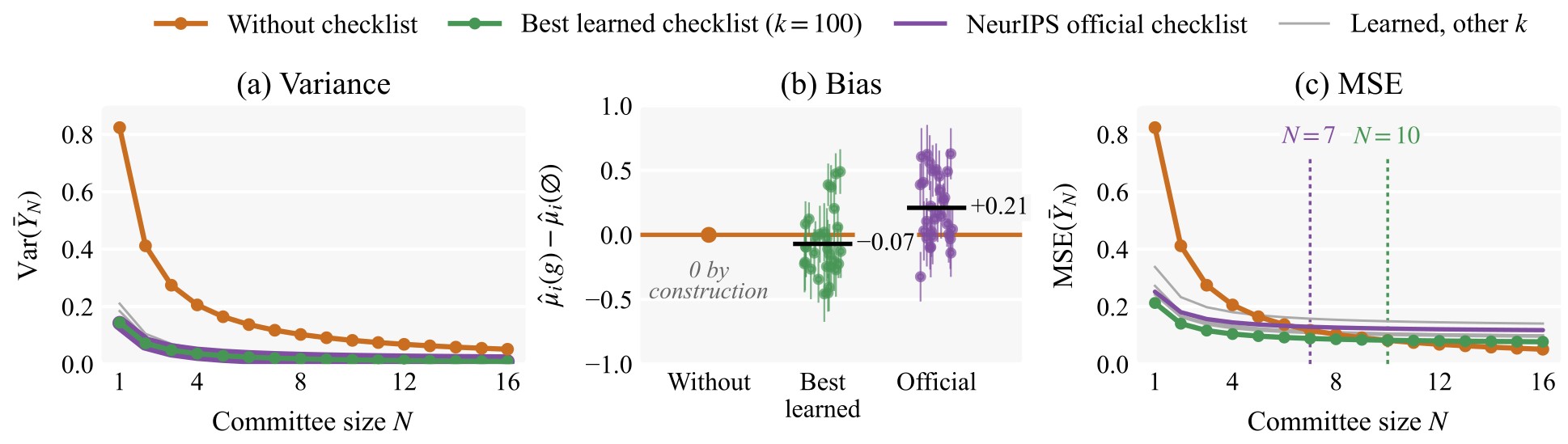
With the 100-item checklist, a single reviewer's error on NeurIPS drops from 0.82 to 0.21, and a committee of four halves its error (0.21 to 0.10). The official NeurIPS 2021 checklist lowers variance just as much but adds more bias, leaving it about 0.04 worse at every committee size. On ICLR, a single reviewer's error drops from 0.84 to 0.34.
ECA also picks the right granularity. On both venues, the checklist with the highest ECA has the lowest error for every committee of three or more, and the one with the lowest ECA has the highest.
In a human study, 20 participants ranked two sets of three NeurIPS 2021 papers, one set with the checklist already filled in by an LLM and one without. Measured against the NeurIPS order, ranking error fell from 0.48 to 0.22; for a committee of three, from 0.32 to 0.11.
Team
This is research from the Epistemic Decisions Lab at Northwestern University by:




Publication
This work is under review at ICLR 2027. The preprint is available here (PDF).
@misc{liu2026checklists,
  title={Learning Checklists to Reduce Lottery Effects in Scientific Peer Review},
  author={Liu, Xuanyou and Guo, Ziyang and Hartline, Jason and Hullman, Jessica},
  year={2026},
  note={Under review}
}