Xuanyou Liu
CHI 2027 · Full Paper · Under Review

Arm Posture and Wrist EIT

How arm posture affects wrist EIT hand sensing, and how to make it robust

Authors withheld during anonymous review

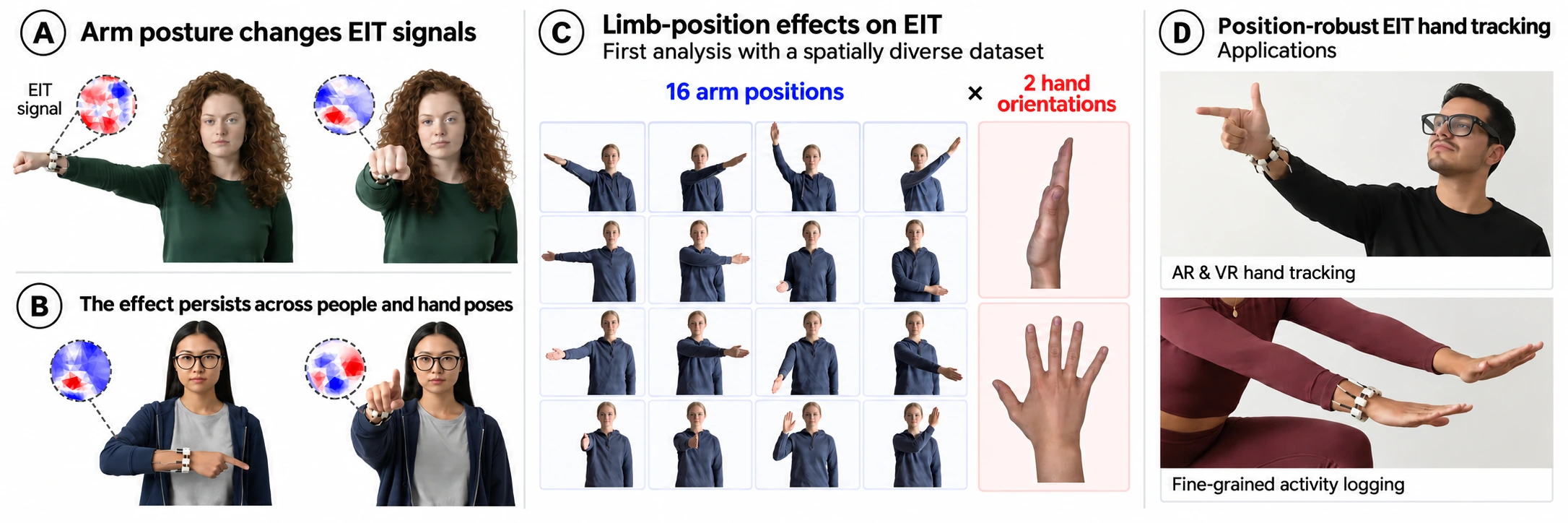
Four-panel overview. A: a wristband wearer makes the same fist with the arm in two positions, and the reconstructed EIT signal circles differ. B: the same effect for another wearer and a pointing hand. C: sixteen arm positions in a four-by-four grid beside two forearm orientations, palm left and palm down. D: applications in AR and VR hand tracking and fine-grained activity logging.

Overview

A wristband that reads electrical impedance tomography (EIT) can follow the hand without a camera: tiny currents cross the forearm, and moving tendons and muscles change the voltages. But a wrist is attached to an arm, and the arm does not stay put. What happens when the same hand pose is held at a different arm position?

We recorded 22 people holding 12 hand poses across 32 arm postures, measured how far the signal and the prediction error move with the arm, and tested two remedies: covering more arm positions in training, and learning representations that know about the user and the arm position.

20–30% higher error at arm positions unseen in training, across four learned models
up to 31% lower error at held-out positions from adding arm positions, not people
12% · 15% lower error for new users · new arm positions with contrastive learning

Same hand pose, different arm position

Hold a fist with the arm forward, then overhead. The hand has not changed, but the picture the wristband reconstructs has.
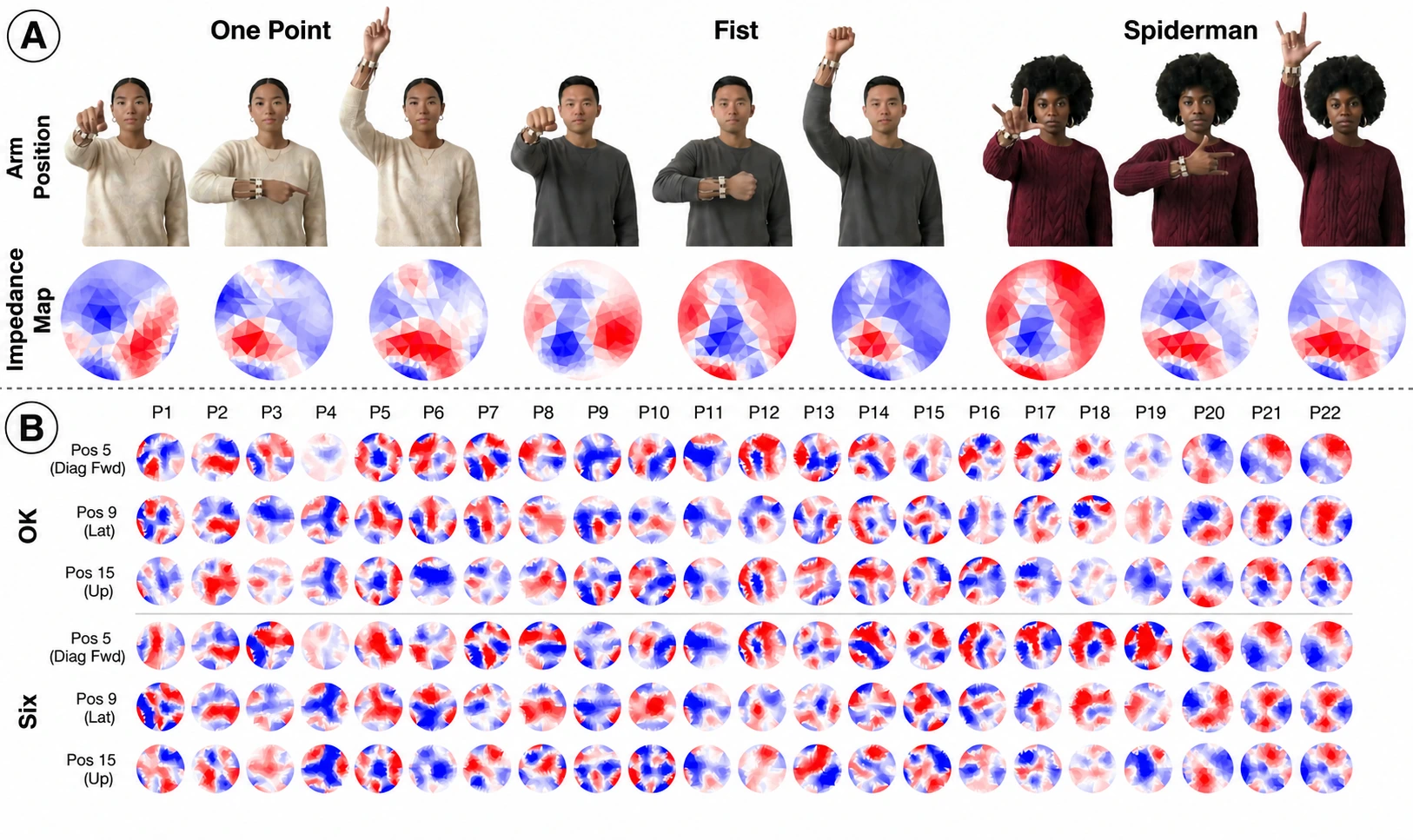
Top: three hand poses (One Point, Fist, Spiderman), each photographed at three arm positions for one person, with the reconstructed circular impedance map below every photo; the red and blue patterns differ between arm positions. Bottom: impedance maps for the OK and Six poses at three arm positions for all 22 participants, again differing between arm positions within each participant column.
One pose, many pictures. Top: the same pose at three arm positions, with the reconstructed impedance map for each. Bottom: OK and Six at three positions for all 22 participants. The patterns move with the arm in nearly every column.

The shift is larger than the signal we want to read. For every one of the 22 participants, the EIT signal for a given pose moved further between arm positions than between different hand poses at one position (median ratio 3.9, paired Wilcoxon p < 0.00001).
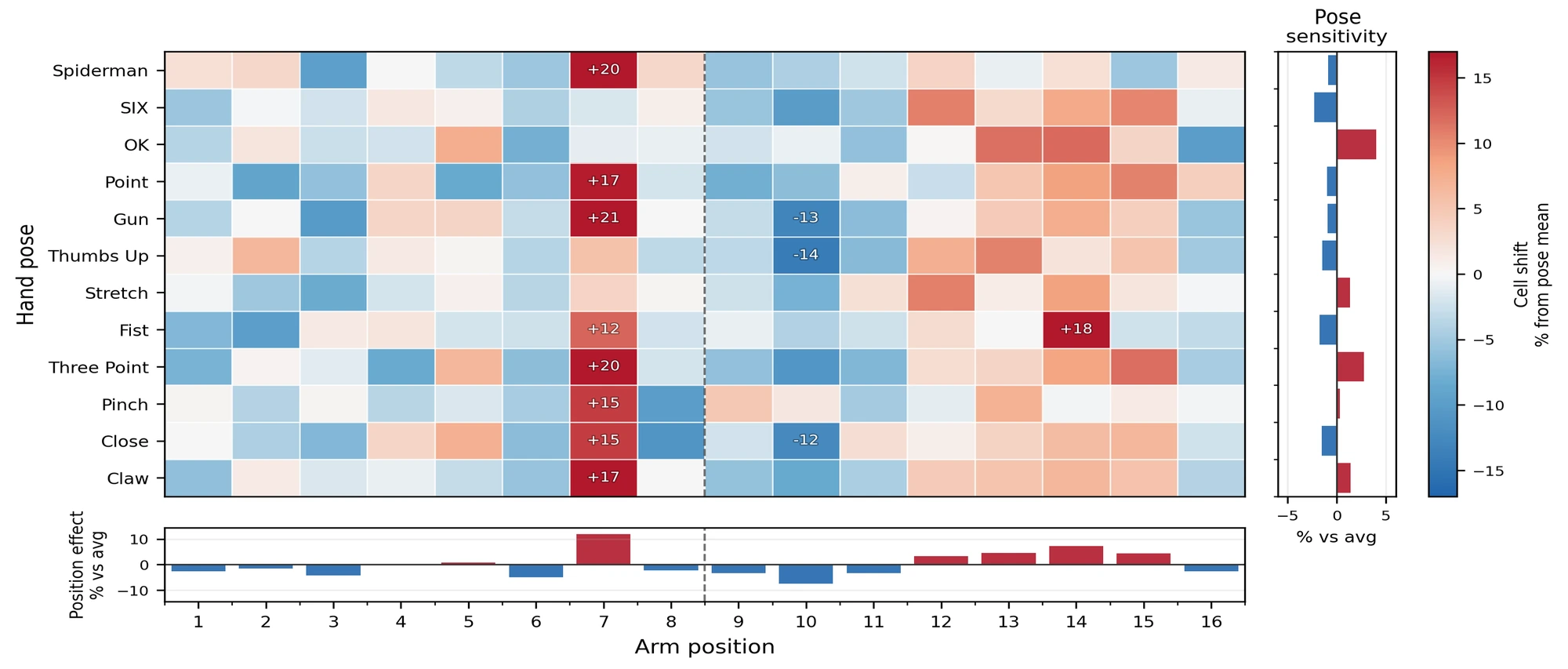
Heatmap with twelve hand poses as rows and sixteen arm positions as columns. Cells are red where the signal shifts more than that pose's average and blue where it shifts less. Position 7 and positions 12 to 15 are red for many poses. Side and bottom bars summarize pose sensitivity and position effect.
It depends on both pose and position. Signal shift for each pose at each arm position, relative to that pose's average. Some positions stand out for many poses, and no pose is immune.
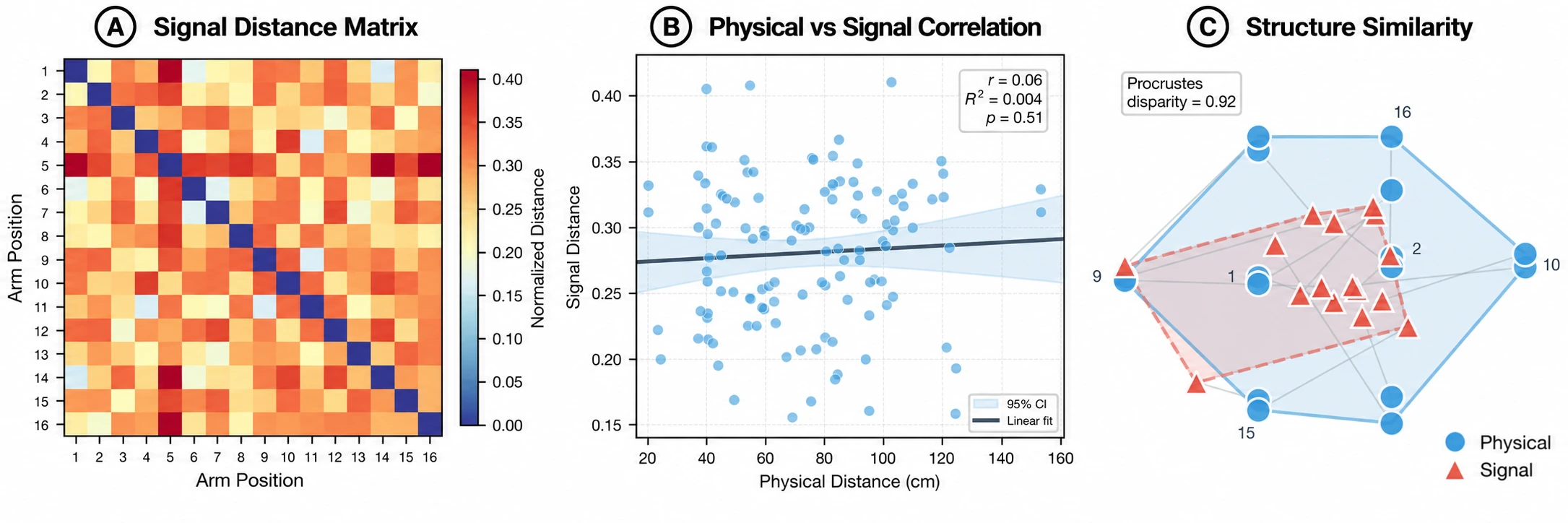
Panel A: a sixteen by sixteen matrix of signal distances between arm positions. Panel B: a scatter plot of signal distance against physical distance with a nearly flat line, r equals 0.06. Panel C: a plot of physical arm positions and a projection of signal space after Procrustes alignment, which have different shapes.
Nearby does not mean similar. Physical distance between two arm positions explains almost none of the difference between their signals (r = 0.06, p = 0.51), so a simple smoothness assumption over position will not rescue a model.

A dataset built around the arm

Participants held each hand pose at a grid of arm positions and two forearm orientations while an EIT band and a headset recorded in sync.
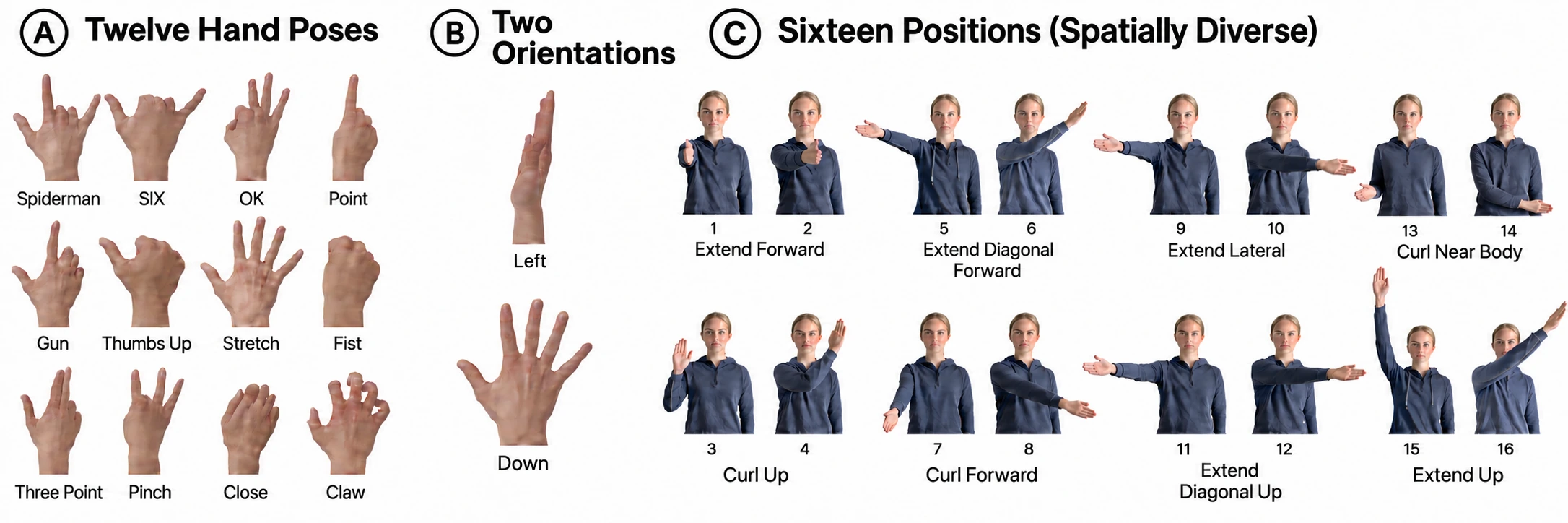
Panel A: photographs of twelve hand poses (Spiderman, Six, OK, Point, Gun, Thumbs Up, Stretch, Fist, Three Point, Pinch, Close, Claw). Panel B: two forearm orientations, palm left and palm down. Panel C: sixteen spatial arm positions grouped into extend forward, extend diagonal forward, extend lateral, curl near body, curl up, curl forward, extend diagonal up, and extend up.
12 hand poses, 16 arm positions, and 2 forearm orientations give 32 arm postures, each performed with every pose.
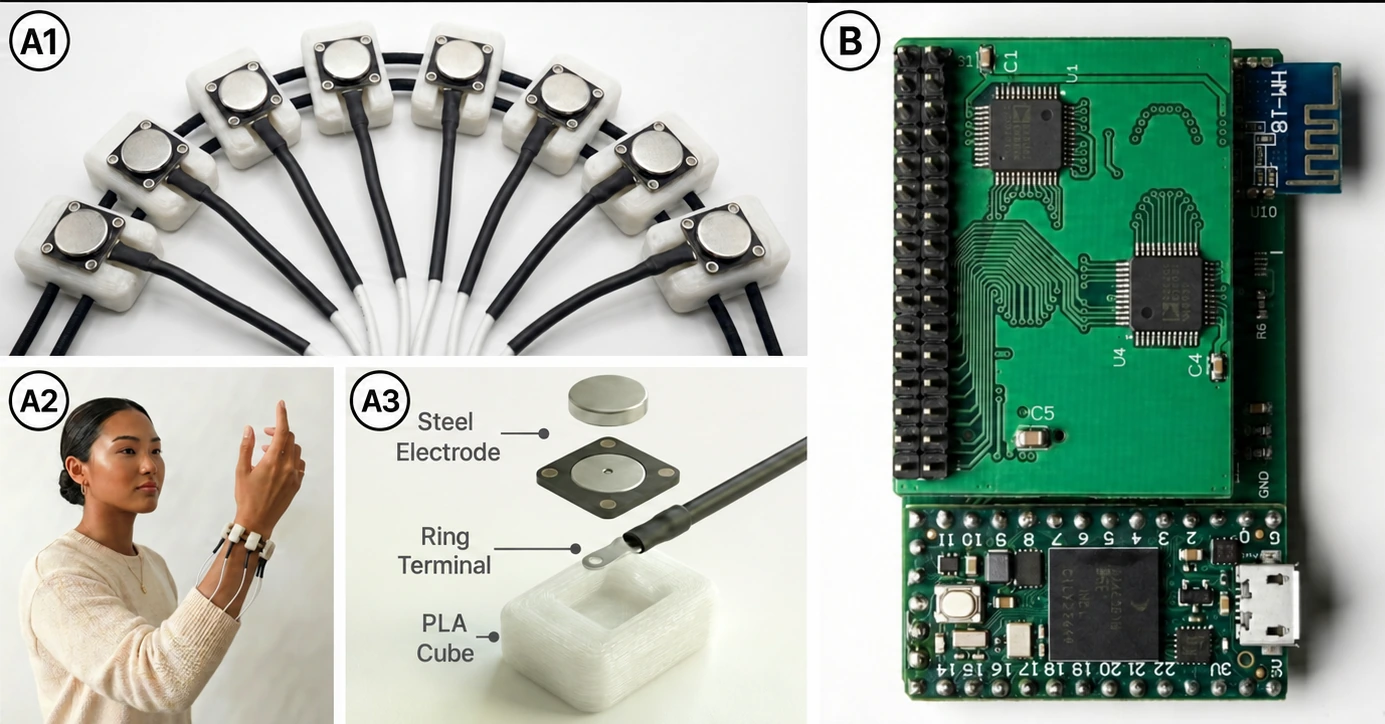
The sensing hardware: eight stainless-steel electrodes in printed housings on an elastic band, a wearer with the band on the forearm, an exploded view of one electrode with its ring terminal and printed housing, and the green sensing board with a microcontroller.

An eight-electrode EIT band on the right forearm injects current between adjacent pairs and measures voltages across the rest, giving 40 measurements per frame at about 10 Hz.

Headset hand tracking provides the reference pose. We score 19 joints with mean per-joint position error (MPJPE) in millimetres.

The result is 346,540 synchronized frames from 22 right-handed participants, about 30 minutes each.

What the arm costs a pose estimator

Train a model at one arm position, then test it at the same person’s other positions. Error rises by 20 to 30% for every learned model we tried.

+20% Extra Trees, 12.5 to 15.0 mm
+25% network from prior EIT work, 11.4 to 14.3 mm
+26% temporal CNN, 11.4 to 14.3 mm
+30% Transformer, 11.1 to 14.4 mm

Each model is trained per participant and per arm position, then scored on held-out data at the training position and at that participant’s other positions. A constant-pose baseline that ignores the EIT signal rises only 10% over the same comparison, so the learned models lose more than a shift in the poses themselves would explain.

Fix 1: cover more arm positions

More people at one arm position barely helps. More arm positions does.
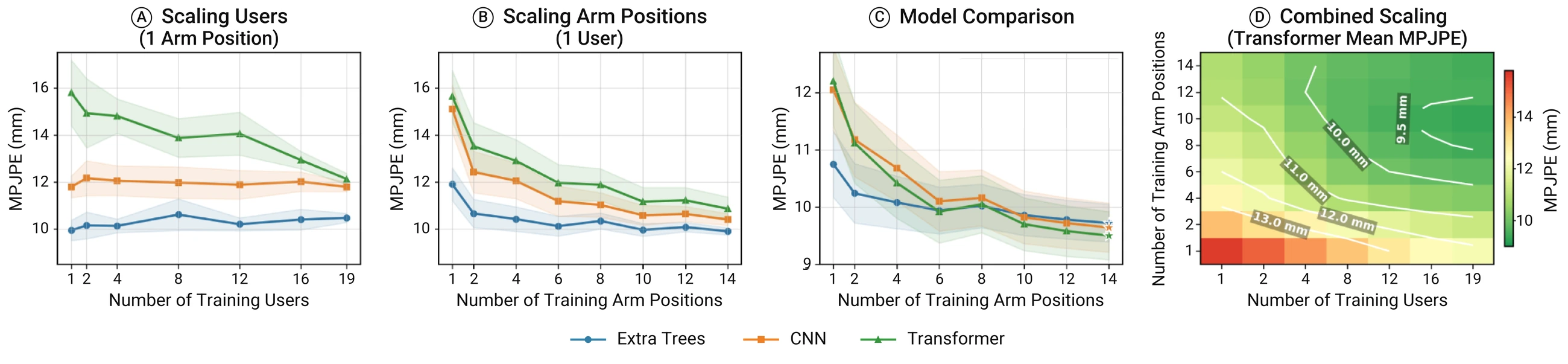
Four panels of error in millimetres. A: error against number of training users at one arm position, nearly flat for Extra Trees and CNN and falling for the Transformer. B: error against number of training arm positions for one user, falling for all three models. C: the same with all participants. D: a heatmap of Transformer error against users and arm positions, with the lowest error at many positions and many users.
Error on a represented person’s held-out positions, averaged over ten random subsets. Going from 1 to 14 training positions cut error by 17 to 31% across three models; going from 1 to 22 people at a single position left Extra Trees and the CNN nearly unchanged. More positions also means more recorded data, so the gain reflects both.

The practical reading: when data is expensive, sample the arm workspace before adding wearers, and report error on arm positions the model has never seen.

Fix 2: tell the model who and where

A small Transformer learns embeddings that group samples by user and by arm position, then fuses them before predicting the hand.
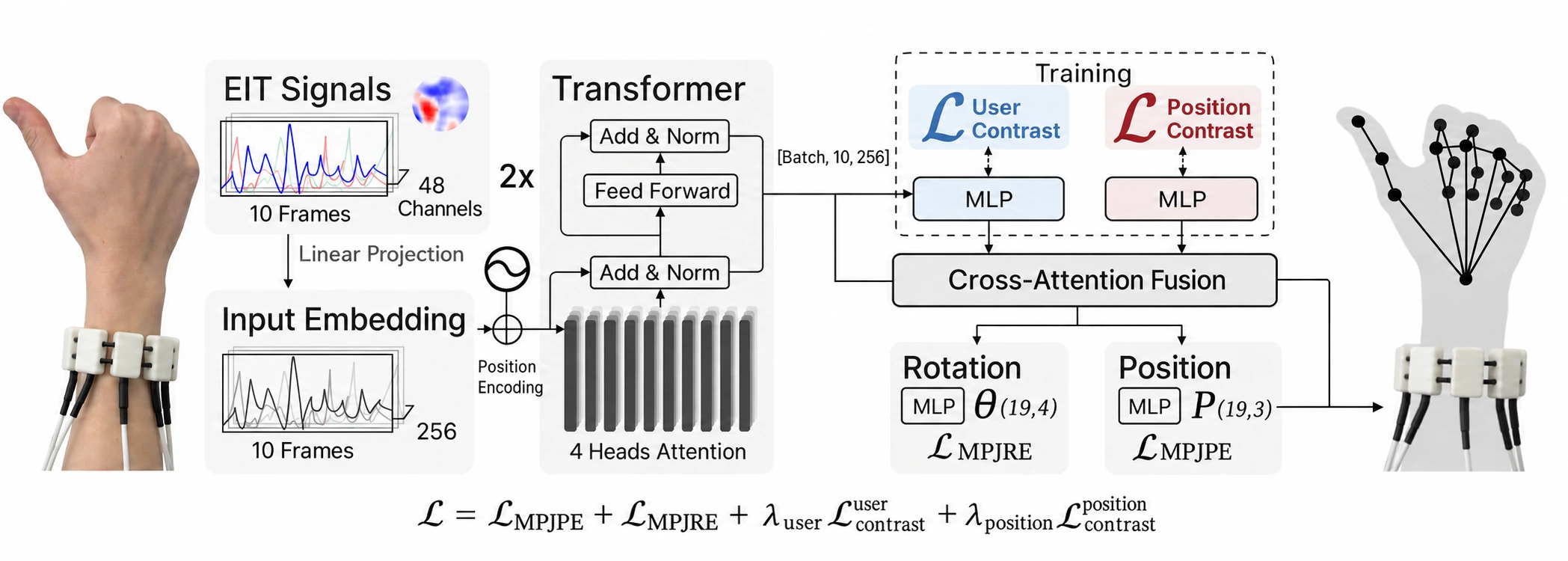
Model diagram. A wristband feeds ten frames of 48-channel EIT signals through a linear projection and positional encoding into two Transformer layers. During training, user and position projection heads feed two contrastive losses. A cross-attention fusion block combines them with the encoded sequence and drives rotation and position heads that output a hand skeleton.
Two contrastive objectives, one by user and one by arm position, shape the embedding during training. Compared with an otherwise identical Transformer, the combination lowers MPJPE from 10.14 to 8.95 mm for unseen users and from 9.25 to 7.85 mm for unseen arm positions.
12% lower error for an unseen wearer
15% lower error for an unseen arm position
p < 0.001 paired one-sided Wilcoxon test, both protocols

What we take from this

The cohort is right-handed, the poses are prescribed holds, each person wore the band once, and the reference comes from headset tracking, so drift across days, free-form motion, and higher-fidelity references remain open. The dataset and code will be released for research purposes upon publication.

Status

This work is under anonymous review for the ACM Conference on Human Factors in Computing Systems (CHI 2027), full paper track. Author names and the manuscript are withheld until the review process is complete. This page will be updated with the full details afterwards.