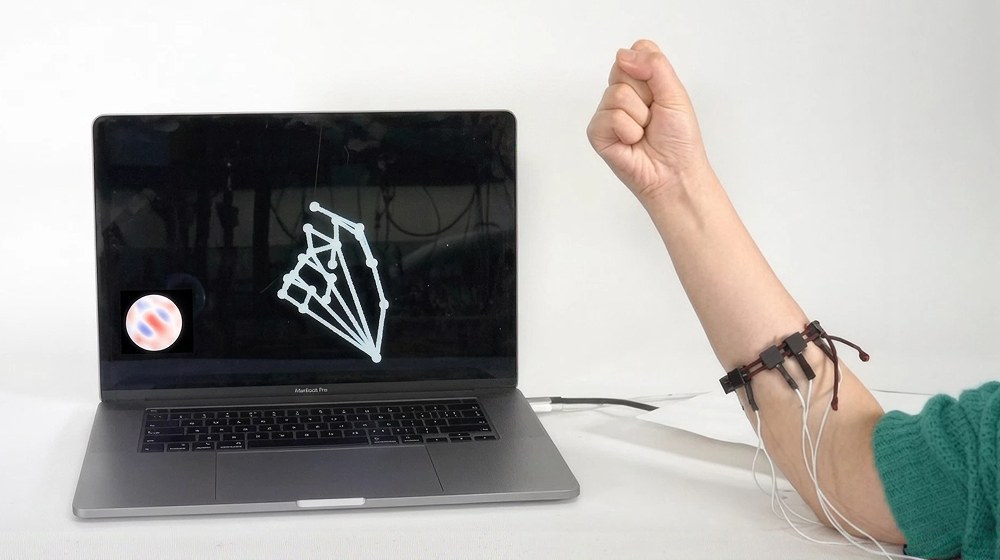



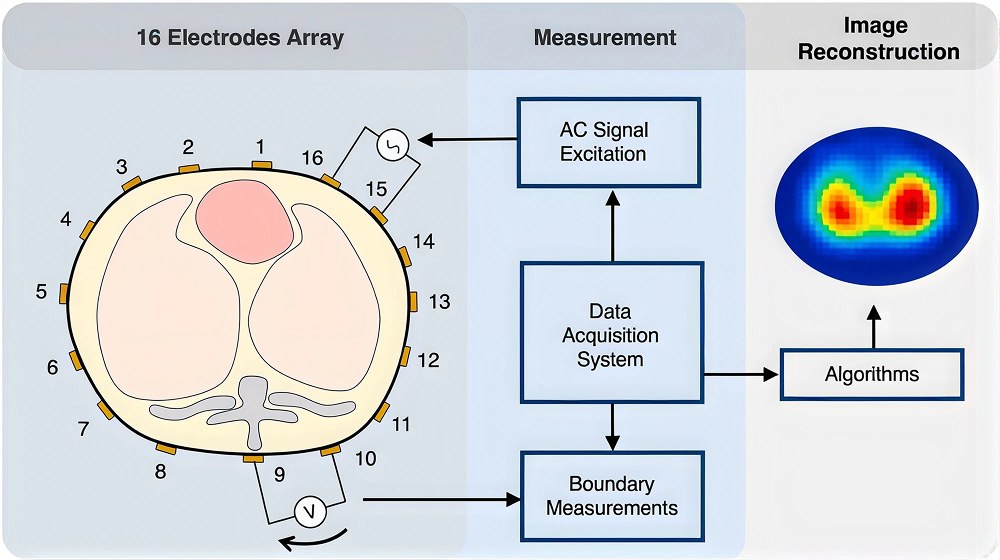
Surround the object with electrodes
Traditional EIT usually treats it as an approximately cylindrical volume.
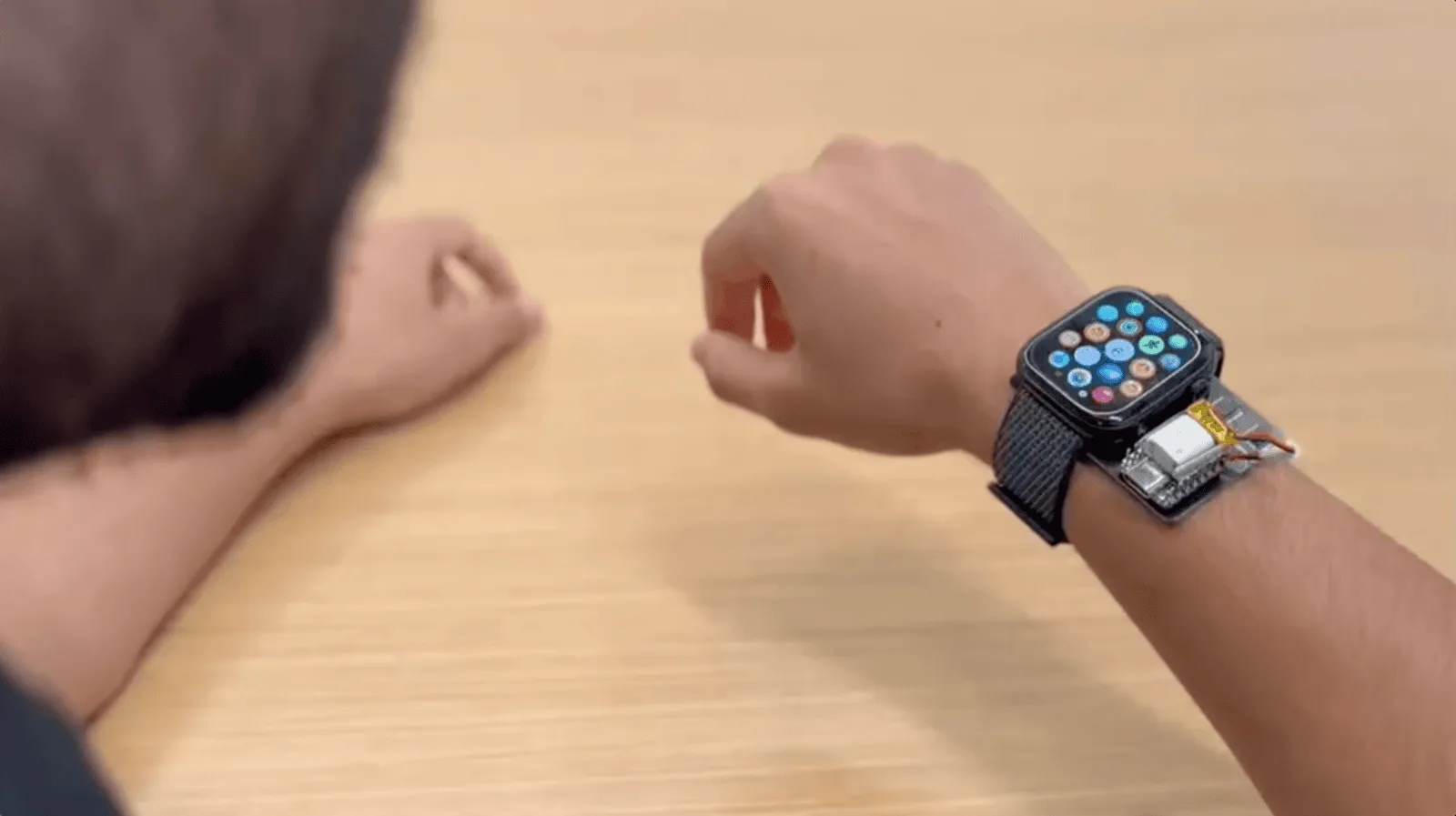
A smartwatch presses its case back against your wrist all day. EITWatch turns that patch into a gesture sensor with electrical impedance tomography (EIT): tiny currents pass between electrodes while voltages are measured, and moving muscles and tendons give each gesture its own electrical signature.
Prior wrist-EIT wrapped a band around the whole wrist plus external electronics. EITWatch is the first system built around the watch’s own case back: eight electrodes in a 31 mm ring, 35 measurements at 48 Hz. Is that small patch alone enough to recognise gestures?
Electrical impedance tomography reads muscle motion from the skin; EITWatch asks whether a flat watch-back patch alone can carry that signal.
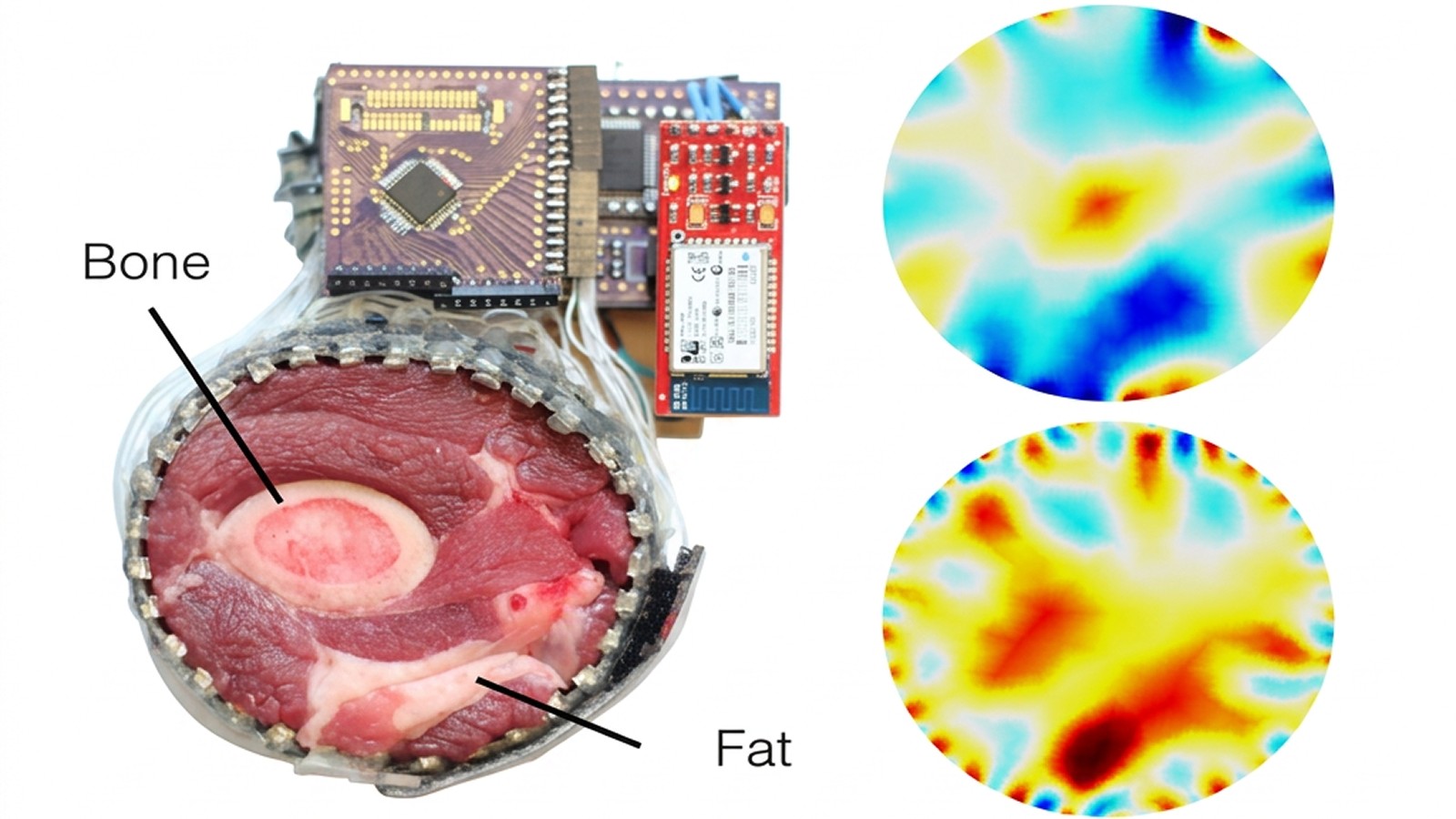
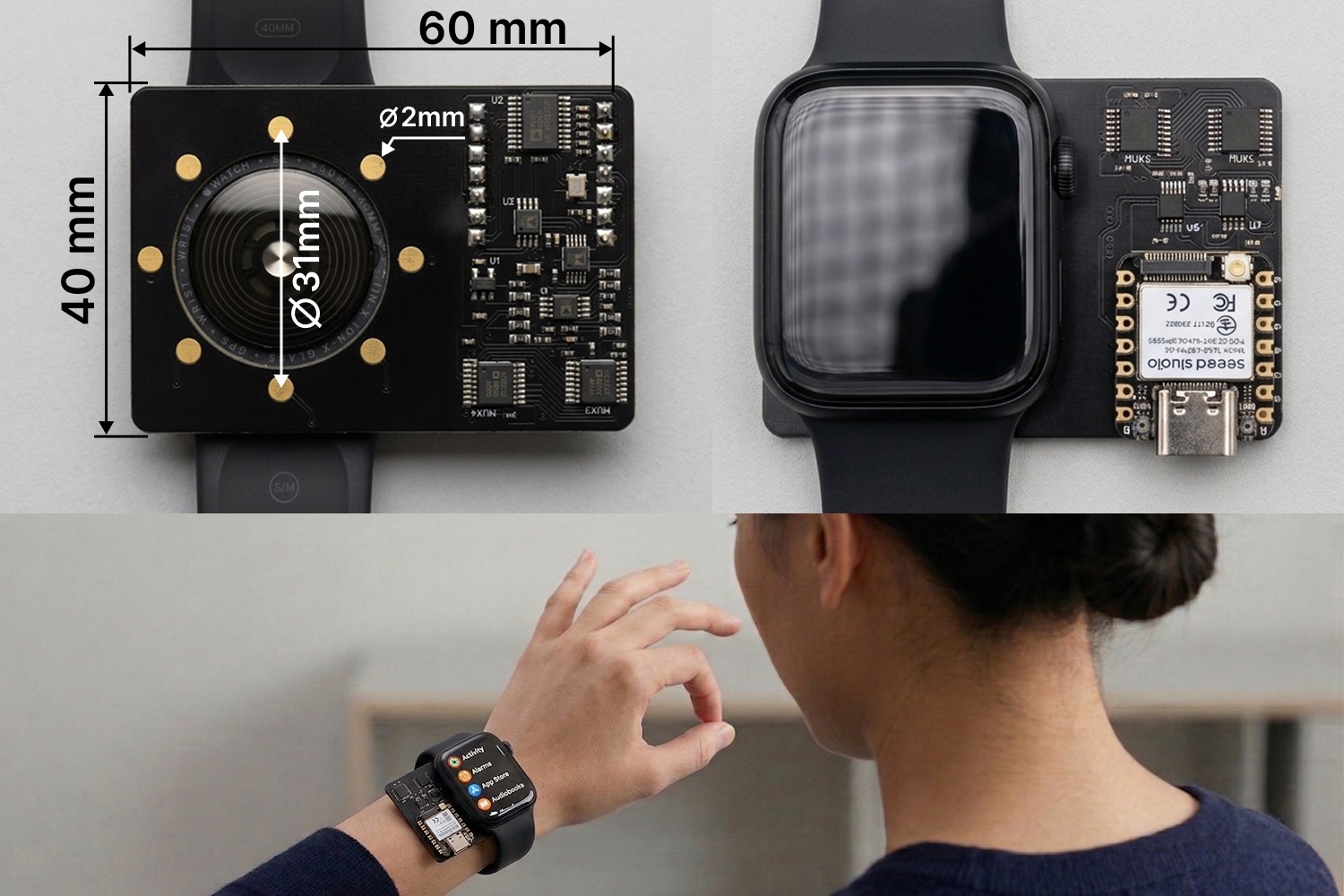
Eight electrodes under a standard watch case, measuring and classifying on the watch itself.
Eight gold-plated electrodes sit in a 31 mm ring beneath a standard 40 mm watch case. A dual-core microcontroller takes 35 measurements per frame at 48 Hz and runs the gesture model onboard.
Current between neighbouring electrodes stays shallow, so one electrode acts as a fixed source while the return steps through the other seven: wider separations reach deeper tissue.
Twelve participants performed prompted gestures; VR hand tracking verified the macro poses. They returned two days later to re-don the watch. Recognition is deliberately lightweight: low-pass filtered signals, sliding windows, 175 simple features, and an ExtraTrees classifier, a randomised variant of the random forest.
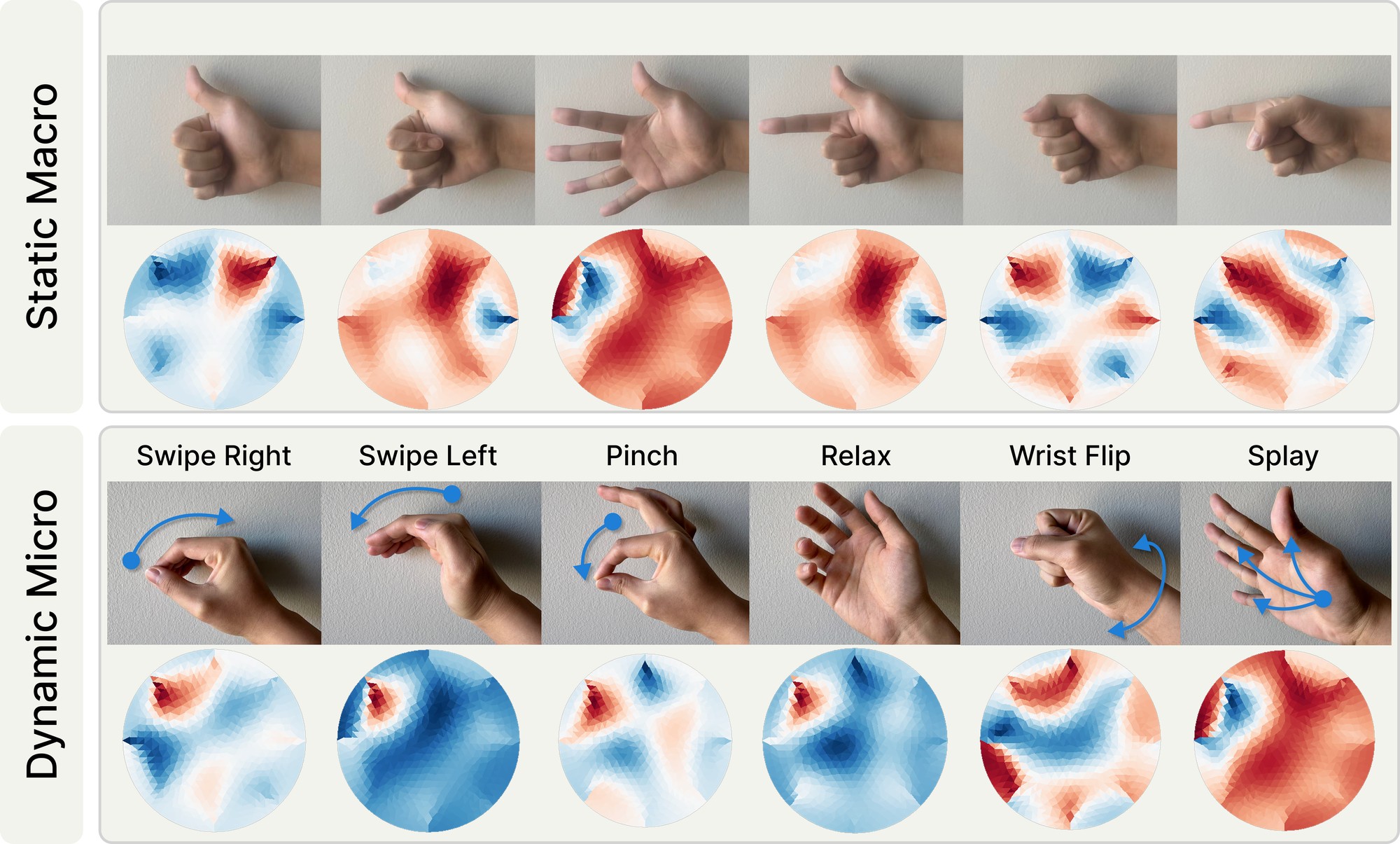
Participants performed two gesture vocabularies: six held poses and five quick, subtle micro-gestures plus a relax class. Within a session, recognition reached 92.5% for the held poses and 91.5% for the micro-gestures.
Recognition across sessions and across people remains difficult: re-donning the watch two days later dropped accuracy to 73.2% and 70.4%, and a brand-new user with no training data managed 63.1% and 55.3%. Closing that gap is the open challenge.
Cross-session and cross-user recognition remain the bottleneck. Next, we will use representation learning and contrastive learning to learn gesture embeddings that stay stable across donning, days, and people, improving generalizability without a full retrain for every wearer.
This is research from the SPICE Lab at Northwestern University by:
EITWatch will appear at the ACM Symposium on User Interface Software and Technology (UIST ’26), November 2–5, 2026, in Detroit, Michigan. The preprint is available on arXiv, and the authors’ print is available here (PDF). Open hardware and firmware (schematics, Gerbers, BOM, and ESP-IDF firmware) are available on GitHub. The release was also covered by Hackster.io, CNX Software, and Borncity.
@inproceedings{liu2026eitwatch,
  title={EITWatch: Smartwatch-Integrated Planar Electrical Impedance Tomography for Hand Gesture Recognition},
  author={Liu, Xuanyou and Alam, Novel and Ahuja, Karan},
  booktitle={Proceedings of the 39th Annual ACM Symposium on User Interface Software and Technology},
  year={2026},
  note={To appear},
  doi={10.48550/arXiv.2608.29415},
  eprint={2608.29415},
  archivePrefix={arXiv}
}