Xuanyou Liu - HCI Researcher at Northwestern University

Hello, I'm

Xuanyou Liu (Zed)

HCI Researcher

Department of Computer Science
Northwestern University · MU Collective · Jessica Hullman

Wearable SensingHapticsHuman-AI Decision-Making

About

I build closed-loop systems that sense, complement, and intervene.

I am a graduate student in Computer Science at Northwestern University (MU Collective), advised by Prof. Jessica Hullman. My earlier projects built wearable sensing and stimulation; at MU Collective I design interactive systems that provide information with high complementarity for human-AI joint decision making.

My papers have appeared at ACM CHI, UIST, and CVPR, and I have given invited technical demos at Qualcomm and Google.

Before Northwestern, I was a research assistant with Prof. Pedro Lopes at the University of Chicago (HC-Integration Lab), with Prof. Karan Ahuja at Northwestern (SPICE Lab), and with Prof. Teng Han at ISCAS.

News

Research

I build closed-loop systems that sense human state, model complementarity to decide when and how to act, and intervene through haptic feedback. Looking ahead, I aim to build mixed-initiative on-body interfaces that move beyond the screen toward continuous, embodied coordination between people and systems.

EIT for Hand Estimation

Sense · Read human state

EIT for Hand Estimation

Exploring Electrical Impedance Tomography (EIT) as a sensing modality for continuous hand pose estimation, with a focus on miniaturizing hardware into everyday wearables so machines can read human state without cameras.

Northwestern EIT Machine Learning
Human-AI Interaction - Bayesian rational agent framework for human-AI decision-making

Complement · Decide what to show or do

Human-AI Joint Decision-Making

Studying how people and AI should divide labor under uncertainty: when to trust a model, what to show, and how interfaces can optimize complementarity rather than just maximize model accuracy.

Northwestern Complementarity Decision-Making
Wearable Haptics

Intervene · Write back through the skin

Wearable Electrotactile Interfaces

Building compact, high-resolution electrotactile interfaces that stimulate the skin to deliver feedback and sensory substitution, closing the loop by writing interventions back into the body.

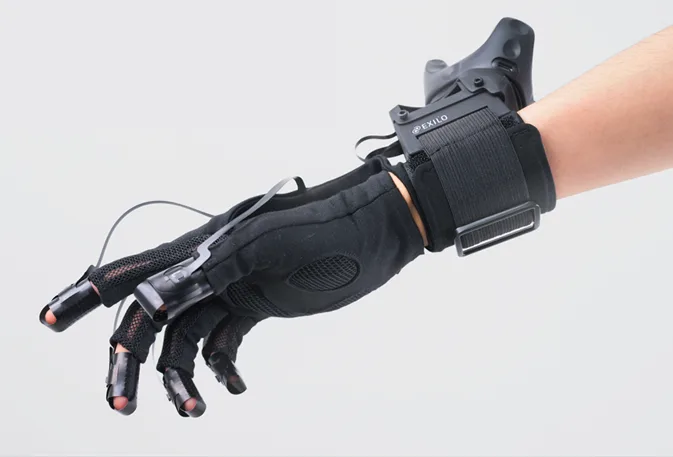
UChicago UPenn Electrotactile Wearables

Publications

* denotes equal contribution

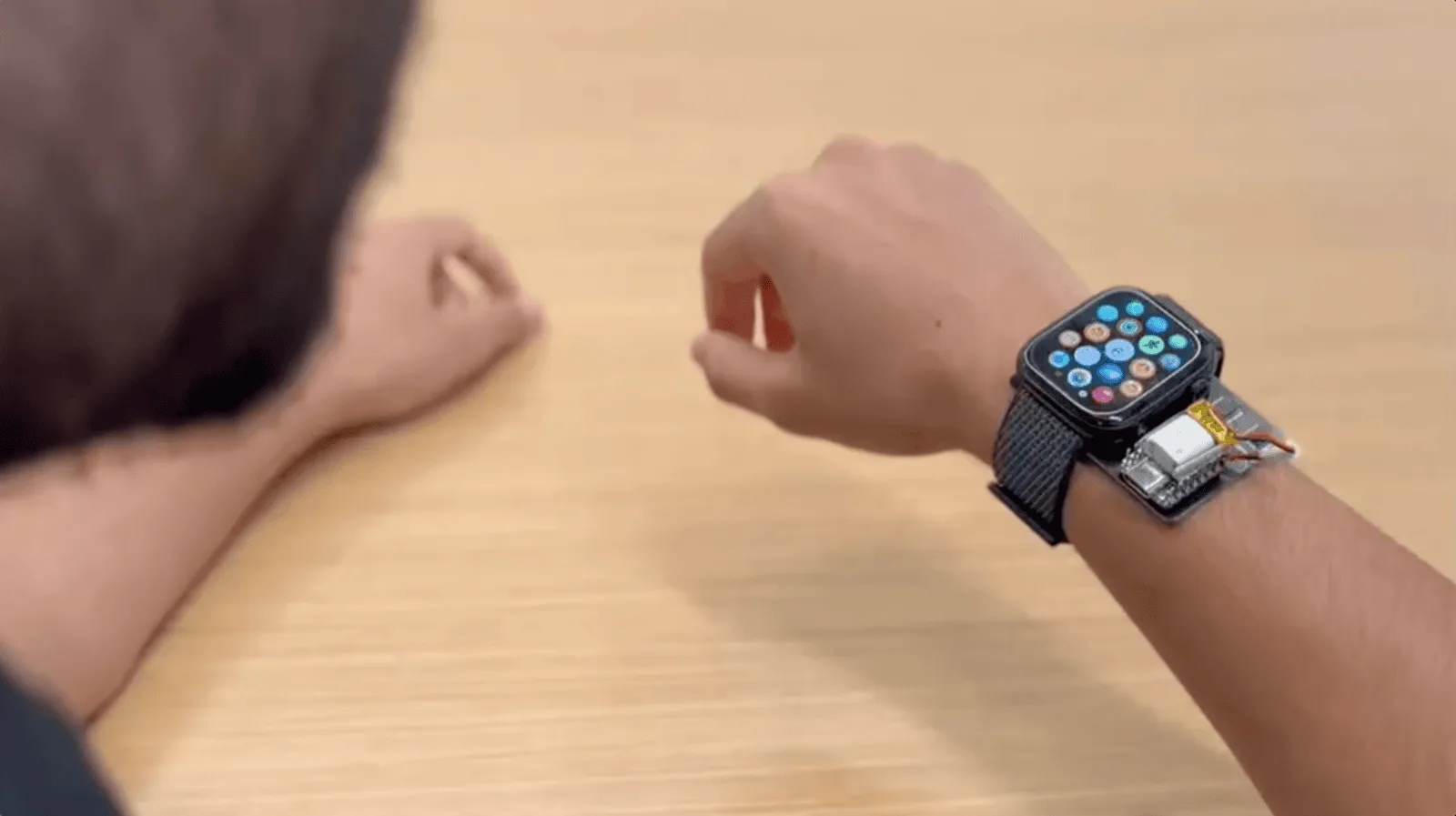
EITWatch smartwatch-integrated planar EIT gesture sensing prototype
UIST 2026 To Appear

EITWatch: Smartwatch-Integrated Planar Electrical Impedance Tomography for Hand Gesture Recognition

Also to be presented as an interactive demo at UIST 2026

Xuanyou Liu*, Novel Alam*, Karan Ahuja

ACM Symposium on User Interface Software and Technology

Wrist Electrical Impedance Tomography (EIT) can sense hand gestures from muscle- and tendon-driven impedance changes without cameras, but prior wrist-EIT systems wrap electrodes beyond the watch-back contact patch and rely on separate analog front ends. We present EITWatch, the first wrist-EIT system built around smartwatch case-back geometry. Eight planar electrodes in a compact ring read impedance from the skin patch the watch already occupies; because a planar array cannot encircle the wrist, EITWatch uses multi-depth scanning to probe tissue along multiple current paths. A user study shows that this watch-back form factor can support both macro- and micro-gesture recognition, pointing toward unobtrusive EIT input on everyday wearables.
MARIO - Multi-sensor inertial odometry with human pose prior for AR tracking
CVPR 2026

MARIO: Motion-Augmented Real-Time Multi-Sensor Inertial Odometry

Yiquan Li*, Taeyoung Yeon*, Chenfeng Gao, Vasco Xu, Xuanyou Liu, Karan Ahuja

Findings of the IEEE/CVF Conference on Computer Vision and Pattern Recognition

Inertial odometry using only IMUs offers a lightweight approach to human motion tracking for augmented reality and wearables, but learning-based methods often drift because they lack explicit models of human motion dynamics. We propose MARIO, which grounds inertial odometry in human kinematics through a learned pose prior inferred from IMU data, promoting physically consistent motion during state propagation. We further develop a sensor-fusion framework that incorporates auxiliary signals from lightweight sensors already available on commercial AR glasses, including magnetometers, barometers, and secondary IMUs. Evaluated on a large-scale motion dataset, MARIO substantially reduces positional drift compared with strong IO baselines and improves robustness across diverse motion conditions, pointing toward lightweight, camera-free human tracking that unifies kinematic priors with multimodal sensing.
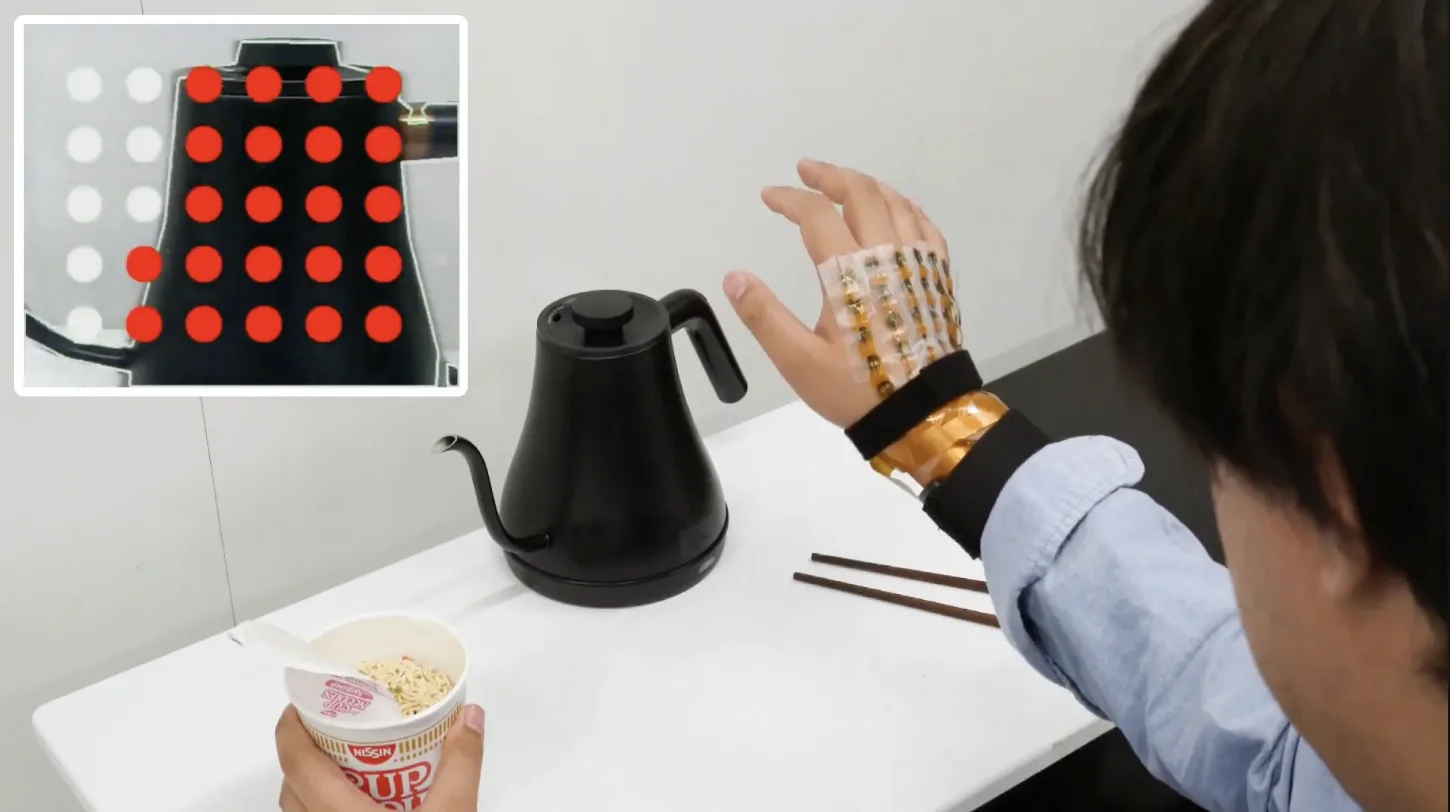
Seeing with the Hands - Hand-mounted electrotactile display for sensory substitution
CHI 2025

Seeing with the Hands: A Sensory Substitution That Supports Manual Interactions

Also presented as an interactive demo at CHI 2025

Shan-Yuan Teng*, Gene S-H Kim*, Xuanyou Liu*, Pedro Lopes

ACM Conference on Human Factors in Computing Systems

Sensory substitution devices enable users to perceive visual information through other modalities, such as touch. However, most existing devices place the camera at the user's eyes (head-mounted), which limits the ability to coordinate manual interactions. We propose "seeing and feeling" from the hand's perspective to enhance the flexibility and expressivity of sensory substitution. To this end, we engineered a back-of-the-hand electrotactile display that renders tactile images from a wrist-mounted camera, allowing users to feel objects while reaching and hovering. In a user study with sighted and blind or low-vision participants, we compared our hand-centered perspective against traditional head-mounted views in manipulation tasks (e.g., handling bottles, soldering). Results indicate that while both perspectives yield comparable performance, participants preferred the flexibility of the hand's perspective, which supported more ergonomic object manipulation strategies.
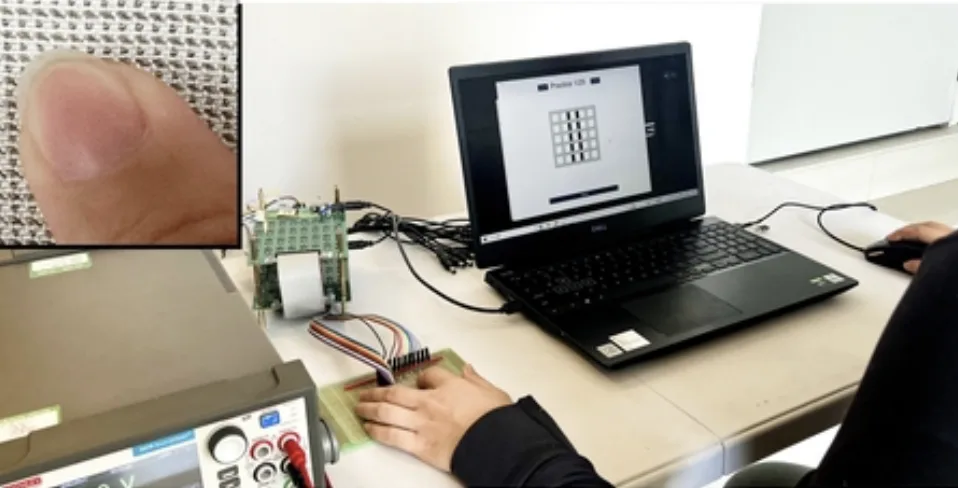
TacTex - High-resolution electrotactile textile interface with woven electrode structure
CHI 2024

TacTex: A Textile Interface with Seamlessly-Integrated Electrodes for High-Resolution Electrotactile Stimulation

Hongnan Lin, Xuanyou Liu, Shengsheng Jiang, Qi Wang, Ye Tao, Guanyun Wang, Wei Sun, Teng Han, Feng Tian

ACM Conference on Human Factors in Computing Systems

Electrotactile stimulation offers a promising path for high-resolution wearable haptics but has traditionally struggled with integration into soft, everyday textiles. We present TacTex, a textile interface that seamlessly integrates high-density haptic feedback and touch sensing. By employing a novel multi-layer woven structure that separates conductive electrodes with non-conductive yarns, TacTex achieves a sensing and actuation resolution of 512 × 512 with electrode spacing as small as 2mm. The system includes a custom driving board that enables precise spatial and temporal control of electrical stimuli while simultaneously monitoring voltage changes for touch tracking. Our technical evaluation and user studies demonstrate that TacTex can render a wide range of haptic effects, including complex static and dynamic patterns, effectively bringing high-fidelity haptic feedback to everyday clothing.

More

Fun projects

  • Handmade LED candle glowing under a glass dome E-Candle
  • Glowing LED earring worn on an ear LED Earring
  • Custom e-ink watch on a wrist showing the word Hello Ink Watch
  • 3D-printed desk robot with animated eyes on a screen RoboPet

Fun facts

  • Blogger HCI and academic life, more than 5,000 followers.
  • Saxophone player Paid player. More than 10 years of practice.
  • Truck driver Drove from Chicago to NYC overnight without resting.
  • Professional Gamer Fruit Ninja top 20 worldwide; NBA 2K top 500 nationwide.
Mudd Hall · 2233 Tech Drive